Showing posts with label book review. Show all posts

Monday, February 11, 2019

Book Review: 'The wise frame their stories with care'


Robertson, Anne. New Vision for an Old Story: Why the Bible Might Not Be the Book You Think It Is. William B. Eerdmans Publishing, 2018. xii + 158 pp. Softcover.
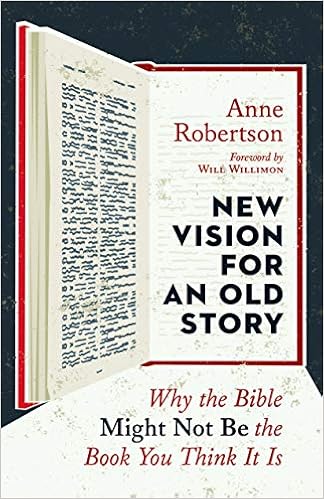
 If you are someone who likes to talk about God, the Rev. Anne Robertson would be a good person to seek out.  Robertson, the executive director of the Massachusetts Bible Society and the author of three books about God as well as the popular Bible study series, Exploring the Bible: The Dickinson Series, now adds to this a book about how we read the Bible.
The phrase ‘Reading the Bible’ can be a showstopper for those who have never entered into a relationship with it.  Some people try reading the Bible from Genesis to Revelation, which usually starts out well because Genesis is full of great stories.  But then you get to Leviticus and there your relationship with God’s Word will end.
In our churches, we typically hear snippets of the Gospels paired with a psalm or other reading from Hebrew Scripture, or from one of Paul’s letters.  Unless your pastor provides it, these few verses seldom reveal any context, making it difficult to get the big picture.  We really need a broader view, if not the whole canvas, in order to gain an understanding about what it is we are hearing.  Reading provides that context, because we can start at Point A and go as far as we want to.  That works well until we can no longer see the forest for the trees.  Hopefully, my metaphors have not been too mixed, but you get the idea: we need a strategy if we’re going to make sense of the Bible.
This is where Robertson comes in.  A gifted writer, she somehow simplifies complex topics – God, the Bible! – even as she opens them up and expands them, leaving us to wonder why we didn’t think of that in the first place.
Her basic premise, one she repeats throughout, is that people are resistant to seeing the Bible as story.  She points out that ‘the Bible’ isn’t just one book, in the same way that ‘Africa’ isn’t a country.  The Bible is a collection of books containing histories, poetry, laments, myths, legends, instruction, wisdom, and truth.  It is a collection of stories meant to invite us into a relationship with God and which can guide us into a life lived in community.
We lose that if we read the Bible strictly as monolithic legal codes or as a textbook.
Robertson deftly navigates us through these other ways of reading the Bible.  Along the way, she removes any hint of intimidation we may have felt beforehand.  In fact, after reading any of Robertson’s books, especially the Exploring the Bible series, you will be inspired to go out and buy a new study Bible, even if you already have one.
Robertson intends to give us a new lens through and by which we can read the Bible fruitfully, and by and large, she succeeds.
As ordained clergy and as the executive director of the Massachusetts Bible Society, Robertson has a unique perspective on how people perceive the Bible.  She gets that perspective the old-fashioned way: she asks people what they think about it.  And, like most clergy, she also has a vested interest in opening access to the Bible to as many people as possible.
Robertson writes with the idea of the Bible as story, not as a law or science text.  She talks about Biblical facts vs. truth, which is an important distinction to make.  People come to the Bible looking for answers and their questions don’t always have to do with how many cubits long God wanted Noah to make the Ark.  People want to know how God can help them, and if they think of the Bible only as dogma or doctrine, they won’t ever open it to look inside.  Neither would I.
So, Robertson begins by explaining the difference between truth and ‘true,’ and how it relates to the Bible.  She talks about God’s involvement in writing the Bible, and whether it is inerrant or infallible (45).  An inerrant or infallible Bible is, she writes, a false choice, if we read the Bible as story.  And that is her main concern: that when we read the Bible, we must read it for what it is: a long, complicated story.
The book includes many helpful sidebars and, at the end, questions for reflection that work for both self-study or in groups.  It is a book meant to be read with pencil in hand, the better to underline the many passages you might want to refer to later.
In her writing, Robertson typically aims at a general audience but one which includes regular church-goers, though she is also trying to reach anyone who has ever struggled with reading the Bible for instruction, hope, or inspiration.  Anyone involved with church, whether ordained clergy or a lay person, can use a book like this.  Anyone who is reluctant to approach the Bible would do well to start with this book.
In talking about the Bible, scholar, theologian, and translator Robert Alter says, ‘It is always better to trust the concrete language of the biblical writers, which is more frank and energetic than any decorous paraphrase.’[1]  This Robertson does well.  Her prose is clean and easy to read yet filled with wisdom and insight.
We don’t necessarily agree on everything – is there such a thing as too much pizza or chocolate-covered bacon? (16) – but there is nothing to infuriate either.  When I read that ‘if you’re a Christian, it’s almost necessary to believe God had some hand in shaping the Bible’ (51), my first thought was, ‘What if I’m Jewish?  And, being a Massachusetts native who lives in the southeastern part of the state, I want her editor to correct her claim that the ‘Mayflower passengers established the Massachusetts Bay Colony (68).’  The separatist Pilgrims on the Mayflower established the Plymouth Colony, not the later separatist Puritans who did establish the Massachusetts Bay Colony.
Robertson writes that ‘the wise frame their stories with care,’ (17) and in this book, she carefully gives us an invitation to enter into a relationship with the Bible in a new way.  She opens the door to understanding a complex collection of books by showing how to read it as a story – a long, sweeping arc of a story intentionally told (21) – and not as a legal code or a science textbook.  Nor is it meant to be taken literally.  In my experience, the only people who take the Bible literally seem to be atheists.
Depending on what the Bible means to you, do you want to know what the Bible says, or do you want to know what it means?  Robertson does not pose this as a question (107) but I do.  What she does do is give us new vision – new eyes – with which to see the Bible as an ancient collection of books containing poems, history, law codes, and, above all else, as a guide to human nature and the human condition.
The Massachusetts Bible Society's mission statement says that the organization ‘exists to promote biblical literacy, understanding, and dialogue that is grounded in scholarship, socially relevant, and respectful of the many voices within the Bible and all those who turn to the Bible in faith.’  As the head of that organization, Robertson is doing a fine and enthusiastic job in fulfilling that mission.

Friday, August 5, 2016

Book Review - Music and the People of God


da Silva, Jetro Alves. Music and the People of God. Self-published in Lexington, KY, 2016. viii + 121 pp. Softcover.

 Jetro Alves da Silva is an accomplished musician, having worked with Whitney Houston, El DeBarge, and others; a theologian; a student of music history and music in the Bible; and a proponent of the power of music to heal and transform.  In the abstract to his book, Music and the People of God, da Silva states that the project aims to ‘discuss the role of music among the people of God’ and its use through the centuries (iv).
This review offers a brief summary, a critique, and my assessment of the work.  Full disclosure: the author and I attended classes together at Andover Newton Theological School in Massachusetts.  Who knew then that he had such a story to tell?
Broadly speaking, this is a book about music and faith.  It examines music from ancient times forward to today, with an extended discussion on the role of music in the Hebrew Bible.  Along the way, da Silva asks himself many questions about all the aspects of music and its role in faith formation.  His questions lead him into the psychology of religious experience and the theology of music, its history and its purpose.  He takes us on a survey of musical tastes ranging from the ancient Egyptians to Martin Luther and John Calvin to 50 Cent and Jay-Z.  His references are extensive and his research impressively deep.  He knows his topic well and intimately.  Much has been written on the social history of music but I am not sure anyone else has quite taken the approach presented here.
 
Da Silva believes that music has ‘the power to make a simple lyric or a powerful philosophical statement become digestible to the one who is listening’ (1).  In that sense, I believe his intention in writing this book is to draw a line from the music of nature – the sound of the waves of the oceans, bird song, trumpeting elephants, the sound of tree leaves moving in the wind – directly to the music of the people of God in praise of God.  For da Silva, music is both mystical and spiritual, and he connects it with the Holy Spirit, the third person in the Christian Trinity and the ruah of the Hebrew Bible.
As a musician and performer, and then as a music teacher and trained theologian, da Silva has traveled widely and acquired vast experience both personally and professionally.  From Brazil to Brooklyn, West Africa to Los Angeles, to Boston and beyond, da Silva’s exposure to a variety of musical forms gives him a unique perspective on his topic.  All that he has learned in his craft has focused his thinking about the role of music and its use in spiritual and religious settings.
The idea behind the book, the thing that animated Jetro’s urge to write, is that musicians can give their best to the Lord, to glorify God, to keep God at the forefront of their thoughts in their playing, singing, and even in their rehearsing.  In our listening and in our appreciation of the musician’s efforts, music can be a means to grace, emotional healing, transformation, and to sanctuary.  Through its long history as a means of human endeavor, through all its forms from primal drumming to modern Jazz and hip-hop, music has generated joy, controversy, and its own varieties of language, not to mention much that endures in our hearts and minds as rhythms and tunes.  Hearing a favorite song can often transport us back to the time and place when we first heard it, just as a favorite aroma can bring us back to the kitchens of our youth.
Music has been a part of human life experience from the very beginning.  It is used in all aspects of our cultures, in celebrations, funerals, battlefields, religious ceremonies and more.  We listen to music for pleasure.  We create music as an offering.  We present music as a gift to God and to our neighbors.  It has always been thus.  But the musical form is never stagnant.  Throughout its long history, music has evolved, changed, influenced other forms across the nations, and in general has been a constant part of our life together.
The very sounds of the earliest forms of music have been mostly lost to us, though we can pick up traces through ancient sources such as the clay tablets of Assyria, the bas reliefs of Egyptian tombs, and in the psalms of the Hebrew Bible.  Through these, we can know which cultures used which types of instruments and how they used music in all their moods and emotions.  A Hebrew shofar, for example, had a different use and purpose than a Phoenician pipe.  This exploration is just part of the journey da Silva takes us on in this book.
In order to realize this ambitious project, da Silva has appropriately broken his task into discrete, manageable sections.
Four chapters follow a brief introduction in which Jetro describes the groundwork of his own life and experience.  Chapter one offers a summary of musical instrumentation in ancient times and our resources for understanding their use.  Chapter two talks about how music is used as therapy, beginning with King Saul in the depths of his depression, and for emotional and physical healing.  Chapter three discusses music from a theological perspective.  Men like J.S. Bach, Martin Luther, and John Calvin had strong and differing opinions on the use of music especially its use in a church setting.  Luther, a musician, was for it as he believed music was a gift from God.  John Calvin, on the other hand, held the contrary view that music came from people, not God.  Lastly, chapter four addresses music as a spiritual and sacred practice, and forms the heart of the book. 
In my view, as someone with some musical training in his background and as a minister-without-portfolio, this is all fascinating stuff.  In a way, it’s good to know what Luther thought about hymns used in church.  A trained musician looking for a broader view of what it is we do on Sunday, or why, or how it came to be, might find this book to be of great interest.  Even therapists who work with people suffering from PTSD or depression can derive something new here.
Knowing Jetro, I can clearly hear his voice speaking to me from one page to the next.  He keeps to the book’s scope pretty well and seldom strays from his mission to show us the relationship between music and God.  In fact, quite often he goes way beyond just presenting some interesting nugget by offering two or three other points of view, and he almost always moves the ball forward by including his own thoughts and opinions.  His sources extend from the truly ancient to the contemporary, exposing us to a wide range of thinking on a given aspect of the discussion.
One thing jumped out at me as something that might spark a discussion, and that is the dance performed at Herod’s birthday (25).  I’m not sure the goal of the dance per se was to ‘persuade Herod to kill John the Baptist,’ though that was certainly an end result.  The daughter’s goal was merely to please Herod and his (male) guests (Mark 6:22).
At 121 8.5” x 11” double-spaced pages (my copy lacks page 122, da Silva’s C.V.), this first edition print-on-demand book is pretty slender despite the wealth of information it contains.  In a smaller size with a different font, it might feel more substantial.  It is, however, not lightweight in any other way.
There are some typos here and there, too, mostly around the numbering and formatting of just a few footnotes, and sometimes a dropped word, but overall, this is a thoughtfully done academic paper in book form.
Overall, this is a great introduction to a complex topic.  Da Silva tells us where we are going and then takes us there.  We cover a lot of ground, from archaeology to mysticism, but not once did I feel as if I were on my own, even in the midst of the discussion about the relationship between music and neurology and psychology.  In fact, da Silva is quite adept at presenting heavy material at a level appropriate for the reader.
I almost want to join a choir now, or at least to revisit the piano as a tool for tying hymns to sermons.  This book provides greater understanding at several levels, especially in how we experience music from within.
In its current form, I recommend this book to anyone who plays music in church and wants to know more about how we got to where we are today.  Non-church people might not be attracted to this kind of book, but I know some church pastors who might be quite interested.  All I would change is the format, and to fix the few errors in the text.
A great effort by a good man and a great husband and father.

Tuesday, April 26, 2016

Book Review - Blue Note Preaching in a Post-Soul World


Moss III, Otis. Blue Note Preaching in a Post-Soul World: Finding Hope in an Age of Despair.  Westminster John Knox Press, 2015.  xvi + 127 pp. Softcover.

Originally presented as a series of Lyman-Beecher lectures at Yale Divinity School, this slim book includes three chapters, each based on an individual lecture, and four sermons which serve as illustrative examples for the material covered in the lectures.  Moss talks not just about preaching, but also about the history of Black, or ‘blue note,’ preaching, what Valentino Lassiter calls ‘the African American preaching heritage’ (Lassiter, preface, 9).  Like Lassiter, Moss notes that modern day preaching often fails to address contemporary needs.  His lecture series and this book seek to correct that situation.
This review offers a brief summary of the book followed by a critique, and concludes with an assessment and recommendation for the intended audience.
There are as many styles and approaches to preaching as there are preachers.  Moss adds his voice to a long list of authorities on preaching, including his mentor Fred Craddock, David Buttrick, Thomas Long, Kirk Jones, and others.  His influences are many, from Howard Thurman, Abraham Heschel, Martin Luther King, Jr., Frank A. Thomas, Henry Emerson Fosdick, and his parents, Edwina and Otis.  This book could sit on the shelf next to Jones’ The Jazz of Preaching, as the two authors both apply musical metaphors to the subject.
Moss intends to show preachers – any preacher – how to ‘effectively communicate hope in a desperate and difficult world’ (according to the publisher’s description).  Preaching with a ‘Blue Note sensibility,’ that is, preaching with a blues aesthetic (Moss, xiii) as it developed in the black American church in the South, is prophetic preaching; a ‘Blue Note sensibility’ preaches about tragedy but refuses to fall into despair (6).
Writing from the perspective of the black preaching tradition, Moss wants to recover and reclaim this tradition from today’s church ‘where Christianity is nothing more than capitalism in drag’ (4).  Blue Note preaching is meant to challenge the church and the preacher: ‘America is living stormy Monday, but the pulpit is preaching happy Sunday’ (4).  Preaching the Blues tradition is now lost ‘in the clamor of material blessing, success without work, prayer without public concern, and preaching without burdens’ (4).  Moss wants preaching to regain a literary sensibility, prophetic speech, and a powerful cultural critique, and names exemplars of each genre, for example, Flannery O’Connor, Martin Luther King, Jr., and Dorothee Solle (4-5).
For Moss, Blue Note preaching is an oral art, rooted in sound not the printed page, nor is it confined to the pulpit.  It reaches the head, heart, and hopes of the hearer.  It is performed in the sense of ‘using all sensory resources to communicate’ to others, and not performed in the sense of being entertainment (36).  Elsewhere, Moss says that the preacher ‘paints with a homiletical brush upon a spiritual canvas’ (34) but also includes a level of musicality (40).  Blue Note preaching is many things save for the preacher reading an essay from the pulpit.  And yet, Moss says, there is a danger in preaching, for ‘preaching brings the purveyor into contact with a world of conflict and contradiction’ (34).  Amen to that.
In chapter 3, Moss develops the metaphor of digital/mobile culture versus analog/stationary culture.  The digital culture informs Blue Note homiletics.  There is always something new being created from the old.  Jesus moved the culture, metaphorically speaking, from an analog to a mobile, digital culture.  The introduction of movable type and the printing of the Guttenberg Bible further pushed the culture into a digital framework even as it was only part of a stationary, analog culture in terms of who had access to it (48-50).  This analog-digital culture shift is occurring around us all time, and challenges the preacher.
Moss is speaking mainly to preachers, specifically black preachers but anyone who steps into the pulpit on Sunday is welcome to apply what he has to say.  This is a challenging book; not everyone will be comfortable with what they read.  As a ‘person of pallor’ reading this book, my responses ranged from feeling excluded in some ways from this amazing-sounding tradition to feeling inspired to include in my own preaching Moss’ call for preachers ‘to stare in the darkness and speak the Blues with authority and witness the work of God’ (9).  This preaching style ought to be valid not only for black American preachers but to anyone who proclaims the good news of Jesus and his ministry in their preaching.  Moss’ intent, I believe, is to open up the pulpit to powerful witness from any source and not to preach the saccharine platitudes of a ‘happy Sunday’ (4).  Our world, Moss writes, has been designed by shadows, not truth (30).
In a time of civil unrest, Moss sheds light on (a) how we can address the current sense of despair, and (b) provides insight to preachers for ways to address contemporary issues in authentic, relevant ways.  This book offers a good start for anyone to whom this is news.  If you are a text-based, immobile preacher, this might be unsettling stuff.  For a book based on a short lecture series, Moss presents his material in a logical, coherent way with the caveat that some fine-tuning, some light editing, might help tighten it up, but to do this is to risk stifling Moss’ engaging voice which comes through on every page.  He quotes blues tunes, Scripture passages; he brings in just about every musical form from classical to hip-hop.  There are a few typos – Larry Byrd?  Hey, Moss isn’t from Boston, so we’ll let it go.
Mostly, we hear Moss telling us to study out of our tradition.  Blue Note preaching challenges us to do the work, study our craft, and develop our own voices (61).  Though Moss sometimes repeats himself and occasionally makes the odd claim, this book is appropriate for its intended audience.  Moss displays some showmanship, enthusiasm, and the movement of the Spirit through both the lectures and the sermons (number four, How to Get Away with Murder, is worth the price of the book).
The book is significant and timely, given the recent situation in Ferguson, Missouri and the Black Lives Matter protests.  Moss is biased toward preaching the truth and shedding light on injustice.  His background as a preacher at Trinity United Church of Christ in Chicago makes him credible and persuasive.  This work is a useful addition to any preacher’s library, particularly to a non-black audience that seeks understanding and new methods of proclaiming the Gospel.
Critically speaking, the book isn’t perfect but it comes close and it does the job as the author intended it to.  In terms of presenting his ideas in an authentic voice, Moss hits a home run.  He taught me that my way of preaching needs to open up and he gave me ways to do that.  There is much food for thought in this little book and I would recommend it to anyone who preaches, period.
References
Valentino Lassiter, Martin Luther King in the African American Preaching Tradition.  Cleveland: The Pilgrim Press, 2001.
Kirk Byron Jones, The Jazz of Preaching: How to Preach with Great Freedom and Joy.  Nashville: Abingdon Press, 2004.

Sunday, June 28, 2015

Book Review - Exploring the Bible: The Dickinson Series


Exploring the Bible: The Dickinson Series.  Rev. Anne Robertson.  The Massachusetts Bible Society, 2012-2014.  Three volumes, with a foreword by Dr Charles Dickinson.  Softcover.

 In the same way that everyone talks about the weather yet no one does anything about it, many people admit that they want to “get into the Bible” but tend to get stuck almost immediately.  Whether your strategy is to read the entire Bible from Genesis to Revelation in one year or simply to open the Bible at random every now and then, it can be daunting to establish a relationship with Scripture from scratch.  This new series by the Rev. Anne Robertson goes a long way to removing barriers to entry, so to speak.  Designed for a wide range of people, from casual or informal readers studying on their own, to intentional students working in small groups, this three-volume series includes both student texts and corresponding leader texts.  The Exploring the Bible series includes a program that provides a “birds-eye view” of Scripture over six 90-minute sessions complete with homework and student presentations.  One can even earn a certificate of Biblical Literacy, with the courses counting as continuing education units.
The Massachusetts Bible Society exists primarily to promote biblical literacy.  Toward that end, Rev. Robertson claims three “foundational biases” in the presentation of information in the series: the idea that the Bible can be read and interpreted by any interested individuals; that scholarship plays a constructive role in conversation with diverse faith traditions and interpretations; and that a “smidge of skepticism” is a necessary tool for study, in concert with the checks and balances of our reasoning ability, the voices of others, and the “anchor” of our various faith traditions, to build a solid foundation of Bible knowledge.  And that is the point of the series: to open up the Bible as something to be read – whether you want to do that critically or simply for enjoyment.
With this Bible study series, Robertson intends two things: to make us all better Bible readers who can turn to Scripture confident that we will find it a deeply rewarding source of wisdom and insight, and to create a new generation of Bible study leaders in a community setting with courses designed to show leaders how to facilitate group discussions.
The first volume, “What Is the Bible?” gives a broad overview of the Bible and its organization, includes a guide to choosing the Bible that’s right for you, a discussion of how the books of the Bible were chosen, and the role of archaeology in forming our understanding of the texts.  The second volume, “Introducing the Old Testament,” looks at the best-known stories, characters, and themes of the Old Testament, as well as insights into Hebrew literature and the people of the ancient Near East.  The third volume, “Introducing the New Testament,” offers a similar treatment to the Gospels, letters, and other texts important to the early church.
There can be little doubt that some of the content in these volumes will cause discomfort in some readers, especially the sections in Volume II that deal with, for example, the appearance of Cain’s wife in Genesis 4, or the mention of the Nephilim, or, even more likely, when things probably happened versus when they were written down.  Robertson wisely and skillfully confronts the mindset that truth can only equal facts, and puts it aside as quickly as it appears.
The student texts also use timelines as a very helpful tool for gaining context and extra-biblical information.  For example, the Hebrew calendar dates the Great Flood to 2104 BCE, but eight hundred years before that, glass and papyrus were invented and first used (Vol. II, 24).  In this fashion, the author reveals fully-formed societies that were on the move.  The world was a busy place beyond what was happening in the Bible.  Abraham and Sarah didn’t live in a vacuum; their story was shaped as much by the world around them as it was by their faith in God.
In addition to timelines, Robertson makes good use of sidebars, graphs, and photos.  Volume two includes Abraham’s genealogy that shows who birthed whom and the origins of the Twelve Tribes of Israel.  Volume three features artwork both ancient and modern, depicting scenes and personages from the first century.  The appendices in the third volume are valuable on their own, including brief biographies of Jesus’ disciples, discussions on the apocryphal books of the New Testament and on who killed Jesus, and a glossary, among other things.
Most likely, the people who come to this series will be Christians, and for them, volumes two and three will be of great interest, with volume three getting the most attention.  They won’t be disappointed.  The student texts are generally easy reading but at the same time, they convey a lot of information in compact units.  Robertson’s writing flows freely yet her knowledge is scholarly and deep.  To our benefit, she takes the time to identify who was who in the first century, with brief sketches of the Pharisees, Sadducees, Essenes, Levites, and so on.  If you want to know the difference between the Son of Man, the Son of David, and the Son of God, here is a good place to start.
The leader texts are geared toward facilitating group study and they include everything a leader would need to have handy without having to refer to the student text.
A second edition is now available at Amazon.com.  These updated editions fix technical problems with some web site links, standardizes the introductory and supplemental material and fixes errors reported by readers of the first edition.  For more information about the series as a whole and the options it provides for beginning Bible study, check the MassBible.org and exploringthebible.org web sites.
Taken as a whole, this is an ambitious project and is so well-conceived and presented, one hopes for its immediate success.  We root for it to become the new standard for both small-group and individual Bible study.