Wednesday, June 25, 2025

Distant Conversations

 It has been a minute since my last post and as the weather lately has been so flippin' hot, I decided today was a good day to add to the pile.

This painting is called Distant Conversations:


The artist wrote:

Last glimpse of light along the coast before night
twinkling lights in the distance on Fourth Cliff;
slight hint of pink left in the sky. Night.

– Jody Regan (@jodypaints on IG)

Here is my reflection on that:

Through Jody’s hands, God is in the painting. God is in the conversation too, even if we cannot always hear God speaking over the wind and distance. To hear these conversations, we have to be there. We have to make the effort to go to and get into the conversation, as we must do whether we are talking with God or to our spouses, children, friends, or our congregations. To hear something faint, something in the distance, we have to go to it. Otherwise, we can only guess at what is being said.

In these days of turmoil and war, it would behoove us to listen to the other voices speaking over the wind and distance, to maybe go find out what is really being said rather than try to guess the thoughts of people we hardly know.  You want to be sure that what you heard is really that which was said.

Amen.

Monday, August 14, 2023

Power Street


In 1978, an artist named Mad Peck, nee John, designed what is now called The Providence Poster.  The four-panel poster includes a composite of one-liners written by Peck and his friend, Les ‘Doc’ Daniels.

Through witticisms spoken over the years by the pair about their beloved Providence, or Prov, Peck captures truths about New England weather and the human condition.

Providence, Rhode Island Where It Rains Two Days Out of Three
Except During the Rainy Season When It Snows Like a Bitch
(“A Mess, Ain’t It?”)

Boy, he got that right.  If you don’t like the weather, wait five minutes; it will change, as they say.  Peck and Daniels’ comment is so twisted up, it’s funny.  It rains two out of three days except during the rainy season.  And when would that be?  Oh, that would be when it snows.

Then the poster/artist turns serious.


Friendship Is a One Way Street

How many people have been hurt by friends who betrayed them or left them at a moment when they were most needed?  How many people have been screwed by those they trusted most?  The artwork shows a terrible car crash.  Is it a metaphor or a warning to the unwary tourist?  If you look at a map of Prov, you will see that the caption can mean both:


But we all know there is more to life than friendship.


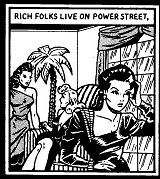
Rich Folks Live on Power Street

The poster was made in 1978, at a time when it was good to be rich in Providence.  According to Ted Widmer, a Providence historian and current director of the Library of Congress’ Kluge Center, “Providence in the ‘60s was a broken-down factory town with a corrupt Democratic administration.”  Peck came of age in the city and learned well.

But money isn’t everything either.


Most Of Us Live Off Hope

The contrast between the two panels is striking, and the two streets exist, appropriately, at right angles to each other in Prov:


Most of us DO live off hope.  Not the kind of hope we express when we say, for example, "I hope the Bruins will win the Stanley Cup" but a deeper kind of hope, defined in the New Testament sense, as full assurance, or strong confidence that God is going to do good to us in the future.

In the Power Street panel, three women are lounging around looking bored.  In the color version of the poster, Peck shows an interracial couple dancing in the Hope panel.  There is hope for us all.

Peck is still active in Prov.  In 2016, the Providence Journal called Peck 'a self-made man of peculiar taste,' whose job description falls somewhere between “renaissance man” and “hustler.” Over the 50-plus years he’s lived in Providence, the Mad Peck has been, at various times and in various combinations, a published comic book historian, nationally-read culture critic, beloved doo-wop DJ, commissioned poster and comic book artist, and television studies scholar, with early side trips through the electrical engineering and applied math departments at Brown University.

If all he ever did was make this poster, it would be enough.


Sunday, July 9, 2023

Biko

Stephen Biko has been on my mind lately, mostly because Peter Gabriel's song Biko keeps popping up on iTunes.

Hearing it reminds me of several things all at once.  Gabriel's song appeared on his third album, one in which he matched innovative music with political material, in songs such as Games Without Frontiers.  But it was Biko that blew the lid off what for many people in the West was a hidden system: apartheid.

Many recording artists have made themselves known by a certain style of music and then produced a song that was totally outside their previous catalog yet loaded with truth, heart-felt emotion, and often, anger.

The Cranberries were known for beautiful songs such as Dreams before uncorking Zombie, a protest song about the Troubles, a song full of emotion, pain, drums, and great guitar hooks.  In the same way, Bruce Cockburn wrote some very fine folk songs that got a lot of radio play, but his music became more progressive and politically-oriented over time.  Then came If I Had A Rocket Launcher, perhaps his best, most honest song.  It spoke of the despair and frustration he felt when he visited a Guatemalan refugee camp in Mexico in the early 1980s.

Even Norman Greenbaum, an observant Jew, came up with something totally different from his usual work.  The song Spirit in the Sky, he said, was inspired by Westerns he had watched on television when he was a kid.  In a Wikipedia article, he said, "The song itself was simple, when you're writing a song you keep it simple of course.  It wasn't like a Christian song of praise it was just a simple song. I had to use Christianity because I had to use something. But more important it wasn't the Jesus part, it was the spirit in the sky. Funny enough ... I wanted to die with my boots on."  In 2011, he said, "It sounds as fresh today as when it was recorded.  I've gotten letters from funeral directors telling me that it's their second-most-requested song to play at memorial services, next to 'Danny Boy'."

Billy Holiday was famous for her haunting rendition of Strange Fruit, which was written and composed by Abel Meeropol (under his pseudonym Lewis Allan).  Nina Simone built a career out of singing unpopular yet incredibly honest and singable songs such as Mississippi Goddam, her first protest song.

These are all powerful and sometimes, out-of-character, songs.

And then there's Biko.

In this song, Peter Gabriel condemned the apartheid system in South Africa.  He condemned the killing of an innocent man.  And he issued a warning to all who heard this eulogy of a song.

September '77
Port Elizabeth weather fine
It was business as usual
In police room 619
Oh Biko, Biko, because Biko
Yihla Moja, Yihla Moja
- The man is dead

From Wikipedia: Stephen Biko was an anti-apartheid activist who was arrested because he would not keep quiet about the injustice of apartheid.  In August 1977, Biko was arrested for continuing to speak out, breaking his banning order.

After his arrest Biko was held in custody in Port Elizabeth, Eastern Cape for several days, during which he was interrogated.  During his interrogation he was beaten by some of the policemen questioning him. He suffered severe injuries, including to his brain, and he died soon after on September 12.

When I try to sleep at night
I can only dream in red
The outside world is black and white
With only one color dead
Oh Biko, Biko, because Biko
Yihla Moja, Yihla Moja
- The man is dead

Only one color dead.  Biko's goal was to overturn an unjust system which, if successful, would also overturn the government.  This made him a threat to the established order.  In the U.S. in recent years, we have seen other innocent men die - killed - simply because they were black and in the wrong place at the wrong time; all they wanted to do was get through the day.

You can blow out a candle
But you can't blow out a fire
Once the flames begin to catch
The wind will blow it higher
Oh Biko, Biko, because Biko
Yihla Moja, Yihla Moja
- The man is dead

And the eyes of the world are
Watching now
Watching now

All of the songs listed here point a finger at those who look the other way.  As Jesus once said to a lawyer, of all people, what do you read there? (Luke 10:26)

* * *

Steven Biko image on a Heerlen church stained glass window.  Artist: Daan Wildschut; photographer: Sergé Technau - Wikimedia Commons, CC BY-SA 4.0, https://commons.wikimedia.org/w/index.php?curid=61673677  

Tuesday, October 11, 2022

Putin's War

 Maybe history will record it as the War of Unintended Consequences.

The Ukrainian people won't care what it's called, just that it ended and they won.  It remains an ongoing disaster, but they have unbounded confidence that they will win.  But not before Putin tries to redefine the whole thing into a war against Russia, of all things.

Writing in The Atlantic on September 30, Anne Applebaum said, "Russia’s actions under these circumstances [those being Putin's recent sham annexation of four Ukrainian provinces] show contempt not only for international lawyers in European capitals, but also for Chinese politicians who like to talk about sovereignty and African diplomats who have agreed that borders matter, even when they are arbitrary. In the upside-down reality that Putin has created, he will now claim that Ukrainians, by defending their own land and their own people, are somehow attacking Russia [emphasis added].

Would he really make such a claim?

Well, the Ukrainians didn't waste any time testing that assertion when they blew up a very nice and crucial bridge connecting Russia to Crimea, which happened to be a major supply route for the Russian Army.

Putin reacted exactly as Applebaum predicted.  The Wall Street Journal reported on October 9 that:

Russian President Vladimir Putin, in his first public comments on the incident, blamed Ukraine and called it a “terrorist attack” aimed at civilian infrastructure.

“Its plotters, perpetrators, and masterminds are the Ukrainian security services,” Mr. Putin said Sunday in a televised recording of a meeting with his top federal investigative official.

Kyiv didn’t claim responsibility for the attack, though senior Ukrainian officials celebrated it on social media.

The nerve of those Ukrainian security services, daring to defend their country!

But then Putin decided to punish Ukrainian civilians with a massive rocket barrage designed to terrorize, kill, and maim.  According to Ukrainian President Volodymyr Zelensky, “The occupiers cannot match us on the battlefield, and that is why they resort to such terrorism.” Mr. Zelensky said this as he stood near a crater left by a strike in Kyiv.

Putin impressed no one, and we suspect he is running out of friends.

In the WSJ report, North Atlantic Treaty Organization Secretary-General Jens Stoltenberg condemned Russia’s “indiscriminate attacks on civilian infrastructure,” writing on Twitter that the Western military alliance would continue supporting Kyiv “for as long as it takes.”

A spokesman for the EU’s foreign-policy chief called Russia’s attacks a war crime. “As always in such cases, the European Union recalls that all those responsible will be held accountable,” spokesman Peter Stano said.

And in Ukraine, Oleksiy Danilov, secretary of Ukraine’s National Security and Defense Council said, “Your attacks provoke only rage and contempt in us! Not fear, not desire to negotiate.”

What a mess.  Even if Putin can pull this off, he has lost the hearts and minds of millions, not to mention their trust and respect.

Maybe they can replace his portrait in the Kremlin with something like this:


Go, Ukraine!

Tuesday, September 27, 2022

'Our captors asked us for songs'

The revised common lectionary this week includes two choices from the Book of Lamentations matched with Psalm 137.  We’re going with the selections from Habbukuk and the Gospel according to Luke, regarding faith, but the other readings are compelling in their own right.

In his commentary on the Psalms, James L. Mays writes that, while Psalm 137 is not one of the 'songs of Zion,' it is a song about Zion.  In songs of Zion, Jerusalem is majestic and invincible, secure against hostile threats and foreign armies.  In this psalm, Jerusalem has been flattened; the psalm is full of pain.

The psalm describes a particular time and place, and the theme is about remembering.  Linda Rondstat even sang a song quoting from the psalm:


The singers vowed not to forget but to remember Zion when they were in Babylon.  The psalm sings of resistance to one city and devotion to another.  And in the end, it also makes an appeal for retribution.

There is faith in our remembering.  Faith can never forget Jerusalem - see Luke 6:6-11 and compare it to Psalm 137:5.

Laments helped the people keep their relationship to Jerusalem alive, in the same way Christians remember Jesus at the Communion Table, to keep that relationship alive.  It's the same for anyone we remember after losing them.  Even Jesus lamented.  Few of us can get through life without some experience that challenges our faith.

Lamentations was written for a specific time and place: Israel’s exile to Babylon.  It was traumatic for the nation.  Families separated, the Temple destroyed; every-day life disrupted.  More than one prophet wrote about it, warned about, and, yes, lamented it.  After the Exodus event, the Exile was the next big thing and is remembered to this day, and for good reason.

How many exile-style events has the world experienced and lived through since the turn of the last century?  We can start with World War I (or, The War to End All Wars; missed that one by a mile), and then move on to the Japanese invasion of Manchuria; the German invasion of Poland; Soviet Russia’s response in eastern Europe; World War II in general; China in North Korea; the French and Americans in Indochina; the revolutionary upheavals in Central America; Lebanon; Syria; Somalia.  And our national lament: 9/11.

That’s just the big stuff.  It’s a long list.  We can add to it the Uighur genocide in China (also documented elsewhere on this blog) and Russia’s recent and ongoing aggression in Ukraine.

The Russians expected Ukraine to crumble.  It didn't happen, and Ukraine, with the help of the West, is fighting back.  Take that, bully.  But Russia (that is, Putin) won't go down easily, if at all.  They can rattle sabers with anyone too.  A new conscription callup may tip the balance in terms of numbers they can put on the battlefield, but Ukraine is proving to be a nimble force of resistance.

Ukraine can win.  Russia, thanks to Putin, can lose.  A lot.

In a world in perpetual pain, Scripture tells us to never forget, to never give in.  To lament for a time, but also to resist.  There is much for both free peoples and the oppressed to lament.

There is always hope and God is always at work in the world.


Thursday, December 2, 2021

Dissension in China

We have talked about the Uyghurs in China before, here and here.  Now we have to talk about tennis players who dare to criticize their government and how it covers up the dirt, so to speak.

Today, Bari Weiss posted this on her blog here (read the whole thing): 

'[The] Chinese Communist Party has now targeted Peng Shuai, a tennis star who accused a former top Chinese government official of sexual assault.  “Even if it is like an egg hitting a rock, or if I am like a moth drawn to the flame, inviting self-destruction, I will tell the truth about you,” she wrote on the social media platform Weibo.  Then her message disappeared.  And so did she.'


Weiss reports that the head of the Women’s Tennis Association, Steve Simon, announced that the WTA was immediately suspending all tournaments in China because of what the country had reportedly done to Peng Shuai.  Here is his statement:

'While we now know where Peng is, I have serious doubts that she is free, safe and not subject to censorship, coercion and intimidation. The WTA has been clear on what is needed here, and we repeat our call for a full and transparent investigation—without censorship—into Peng Shuai’s sexual assault accusation.

'None of this is acceptable nor can it become acceptable. If powerful people can suppress the voices of women and sweep allegations of sexual assault under the rug, then the basis on which the WTA was founded—equality for women—would suffer an immense setback. I will not and cannot let that happen to the WTA and its players. 

'As a result, and with the full support of the WTA Board of Directors, I am announcing the immediate suspension of all WTA tournaments in China, including Hong Kong. In good conscience, I don’t see how I can ask our athletes to compete there when Peng Shuai is not allowed to communicate freely and has seemingly been pressured to contradict her allegation of sexual assault. Given the current state of affairs, I am also greatly concerned about the risks that all of our players and staff could face if we were to hold events in China in 2022.' [Emphasis added]

Good for the WTA!  Good for Steve Simon.  One would think it a no-brainer to come to this conclusion given everything China has its hands in these days.  But money speaks loudly.

We will not hold our breath waiting for the rest of the sports world (and the world of corporate sponsors) to catch up.

Monday, September 27, 2021

Uyghurs: In the News Again

 The Uyghurs are in the news again.

In April, Jonathan Tobin wrote the world ‘is too busy or too intimidated by China to do more than raise a token protest about what’s happening to the Uyghurs.’  See a previous post, here, to learn more about that.

Now, with political tensions rising in Asia (Hello, Hong Kong and Taiwan) along with disputes between the U.S. and China over human rights, national security, and the theft of intellectual property, China still has time to take it to the Uyghurs.

A recent Wall Street Journal article describes how Beijing has seized millions in assets owned by Uyghur business owners.

Eva Xiao and Jonathan Cheng write: "In recent years, China's government has clamped down on the predominantly Muslim and Turkic-speaking Uyghurs and other ethnic minorities in Xinjiang, razing mosques and other religious sites and confining hundreds of thousands of people in a network of internment camps.

"The auction entries also shed light on what Uyghurs say is another aspect of China’s campaign: the dismantling of companies and personal wealth belonging to Uyghur business leaders."

The problem is assimilation, or the lack of it, according to Chinese authorities.  Ethnic minorities in China's Xinjiang region want to remain who they are.  Beijing thinks otherwise.

Xiao and Cheng put it in a nutshell: "Western scholars and rights groups say Chinese authorities level these types of charges as a pretext to implement policies targeting minorities in Xinjiang more broadly. China says it is fighting terrorism and separatism. Uyghur activists say Beijing is intent on destroying Uyghurs’ culture and ethnic identity."

Before the crackdown began, Uyghur business owners were good guys, acting as a bridge between the government and their communities.  Some scholars feel  that the Uyghurs actually helped create interethnic tensions between the Han Chinese majority and the various ethnic minorities, but that seems counter productive to me.

Apparently, Chinese is okay with seizing property and then letting it sit fallow.  Or to seize bank accounts and bankrupt their owners.  As Vito Corleone might say, it's not good business; it's retribution for a failure to come to heel.

This four-story building, adjacent to an iconic mosque in Kashgar, China, was seized from a jailed Uyghur businessman and listed for auction by Chinese authorities.
PHOTO: JONATHAN CHENG/THE WALL STREET JOURNA

Meanwhile, Commerce Secretary Gina Raimondo, formerly governor of Rhode Island, seeks to improve business ties with China.

Bob Davis, also in the Journal, wrote that, according to Ms. Raimondo, Chinese economic policies disadvantage U.S. companies by subsidizing exports at below-market prices and winking at the theft of intellectual property.  Even so, she said the U.S. must trade with China given the size of its market.

“It’s just an economic fact,” Raimondo said in an interview. “I actually think robust commercial engagement will help to mitigate any potential tensions.”

Commerce Secretary Gina Raimondo

What amazes me is how we (meaning the U.S. and the West as a whole) continue to turn a blind eye to what repressive, non-democratic countries inflict on their own populations while we seek to do more and more business with them.  In the case of China, we are more concerned with keeping the smartphone and cheap plastic goods pipelines open than in keeping our allies secure, even while a storm is brewing in the South China Sea.

God help the Uyghurs, not to mention Tibetans, Taiwanese, and Hong Kongers, all of whom have been or continue to be in China's crosshairs.

Wednesday, September 22, 2021

Sunrise Doesn't Last All Morning

George Harrison’s song All Things Must Pass has been in my head since before I woke up.  The internet tells me that this year marks the fiftieth anniversary of the first album Harrison released following the breakup of the Beatles, so maybe that’s why.  It was no surprise to learn that the album has been remixed from the original tapes and re-released in a variety of formats.

Now the darkness only stays the night-time
In the morning it will fade away
Daylight is good at arriving at the right time
It's not always going to be this grey

The foundation stones for the ‘new’ Salisbury Cathedral were laid in 1220.  The original Salisbury Cathedral was completed at Old Sarum in 1092 under Osmund, the first Bishop of Salisbury.  By any measure, these are old buildings.  The original building didn’t last very long but the new cathedral is still going strong.


It’s unclear to me how these two things – Harrison’s breakout tune and Salisbury Cathedral – are connected, but they are, maybe because I’ve been to Salisbury and I know how much Harrison loved the gardens at Friar Park, his country estate.  Somehow, my brain linked them together.


Harrison faded away in 2001.  Salisbury Cathedral carries on, stoically, but requires ongoing maintenance to hang in there, as most of us do.

My parents are both gone now.  My sister recently moved out of the family home and, for the first time since 1949, there are no Aucellas living on Crosby Road.  All things must pass indeed.


Amen and Godspeed.


Tuesday, April 13, 2021

Uyghur Genocide: What Have You Heard?

In a recent column published by the Jewish News Syndicate (Why aren’t Jews up in arms about Uyghur genocide?), Jonathan Tobin writes:

“The Uyghurs are a predominantly Muslim ethnic group who live in the Xinjiang region of Western China. Since 2014, China’s ruling Communist Party has been carrying out a campaign of ethnic cleansing and genocide against them. Acting under the authority of President Xi Jinping, crimes against humanity have been taking place there on an enormous scale, including mass imprisonment, systematic torture, rape, forced abortions and sterilizations. At least 1 million Uyghurs have been sent to the laogai—the Chinese gulag of prison camps. It is the largest systematic assault and imprisonment of an ethnic or religious minority since the Holocaust.”


https://en.wikipedia.org/wiki/Xinjiang_conflict#/media/File:Xinjiang_in_China_(de-facto).svg

Tobin goes on to speak about the two main reasons why the mainstream media seems relatively quiet about this latest and ongoing genocide: politics and economics.  In an article that is especially hard on Jews, Tobin could just as easily be speaking about America and Americans.

He points out that, ‘on its last day in office, the Trump administration formally recognized that what was going on in Xinjiang was genocide, an important step towards treating this catastrophe with the seriousness it deserves.’  A commendable but belated recognition.

The incoming Biden administration has ‘slapped sanctions on Chinese officials directly implicated in the genocide.’

Business Insider reports: ‘The sanctions, which target Wang Junzheng, the secretary of the Party Committee of the Xinjiang Production and Construction Corps, and Chen Mingguo, the director of the Xinjiang Public Security Bureau, were rolled out in coordination with Canada and European allies.’

'"Amid growing international condemnation, the PRC continues to commit genocide and crimes against humanity in Xinjiang," Secretary of State Antony Blinken said in a statement.'

The Chinese then turned human rights violations back on the United States: 

‘Yang Jiechi, China's top diplomat, responded by accusing the US of being condescending. In comments that lasted roughly 15 minutes, Yang said the US government was in no position to lecture other countries on human-rights abuses, alluding to racism in the US as he mentioned the Black Lives Matter movement.’

Stay tuned as this debate will probably continue, with no relief for the Uyghurs.

Additionally, Tobin writes, standing up to China, the world’s second-largest economy, is not ‘cost free:’

‘[The] United States must weigh how its economy has become inextricably linked to that of China’s growing power in determining how to respond to these atrocities.’

The amount of trade in iPhones alone is enormous.  If that were to disappear, you would hear about it.  Also, all politics is local: Tobin points out that activist energy has been diverted to other, ‘more fashionable’ causes, such as the Black Lives Matter movement.  Surely, one would think that activists could muster enough outrage for all human rights causes.

Instead, Tobin writes, the world ‘is too busy or too intimidated by China to do more than raise a token protest about what’s happening to the Uyghurs.’

Fair enough.  We could probably be excused on grounds of pandemic fatigue too.

But Natan Sharansky wrote that there can be no peace with dictators, saying, ‘A society is free if people have a right to express their views without fear of arrest, imprisonment, or physical harm.’ 1    The Uyghurs, then, indeed, all of China, are not free. 

So, are we as a society just looking the other way on this issue?

In her book, How to Fight Anti-Semitism, Bari Weiss offers a list of things we can do to combat anti-Semitism, and they can be used here also.  Here are just two:

Call it out.  Do not be caught in a conspiracy of silence. 2

Never, ever forget to love your neighbor.3   Even if that neighbor is thousands of miles away.  Weiss writes, ‘When someone is attacked because of her identity and not her ideas, see that as an attack on you.’  If Christians heed the call to love our neighbor, then that must also include the neighbors we can’t see or hear.

So, where do we go from here?  If this matters to you, get active.  Call it out.  Ask your elected representatives what they are doing to help.  Keep the pressure up.  Don’t be silent.  Love your neighbor.  And never, ever forget.

Additional Resources:

The Uyghur Genocide, 3 September 2020.

The Uyghur Genocide: An Examination of China’s Breaches of the 1948 Genocide Convention, 8 March 2021.

The US says China is committing genocide against the Uyghurs. Here's some of the most chilling evidence, 2 April 2021.

US accuses China of 'genocide' of Uyghurs and minority groups in Xinjiang, 20 January 2021.

China's Uighur Genocide: Here's Everything You Need To Know About the CCP's Human Rights Abuses, July 22, 2020

Notes:

1 Sharansky, Natan Anatoly. The Case for Democracy: the Power of Freedom to Overcome Tyranny and Terror. Public Affairs, 2004, 40.

2 Weiss, Bari. How to Fight Anti-Semitism. Crown, 2019, 172.

3 Ibid. 188.

Tuesday, June 23, 2020

a darkness that can be felt


[NB: This was included in an online Hour of Prayer hosted by the Hingham Hull Interfaith Religious Leaders Association last night.  Many thanks to all who participated.]

a darkness that can be felt
Then the Lord said to Moses,
“Stretch out your hand toward heaven
so that there may be darkness over the land of Egypt,
a darkness that can be felt.” – Exodus 10:21

A darkness ‘that can be felt’ is not your usual type of darkness.

As you might imagine, there are many possible reasons for this Biblical ninth plague.  One is that the darkness came when a sandstorm blew across Egypt.  In such storms, the wind becomes electrically charged, and it stings against your skin.  It’s a hot, violent wind.  This kind of darkness can certainly be felt, and you might think it is truly the end of the world.

Another explanation says there may have been an eclipse of the sun, but this darkness lasted three days.  Would an eclipse last that long?  Would that be a darkness one could feel?  The Egyptians were unable to move from where they were.  Would an eclipse incapacitate you?


Abraham Ibn Ezra wrote that the darkness ‘was so thick that light from a fire or candle would not ignite.’  Clearly, this darkness was something different.

Maybe this darkness was a form of collective, transient blindness, leaving the people able only to grope about, to feel their way around.

Isaac Abravanel speculated that the blindness of the ninth plague was not an illness unto itself.  He wrote that ‘God brings this upon the people due to the fear of the enemy who wreak havoc that they see with their own eyes…their mind doesn’t think clearly and their sight is distorted.’

So, a threat or fear can bring on blindness to a group of people.  A continually anxiety-driven atmosphere can cause us to regress to the point where we.stop.seeing.

Much like the Egyptians suffering the ninth plague, this may be where we are today as a result of months of pandemic-induced fear and anxiety.  Maybe we have seen too much of it and can see no end.  Maybe too many deferred funerals and weddings and celebrations have left us blind to all the wonders of life that continue to surround us.  Maybe the worries about how we’ll be able to teach our children or visit our loved ones as we move forward have crowded out our ability to see the light within.

Let us pray:

Holy One,
We lift up our hearts to you in thanks and praise.
Help us in this time of trouble.  Dispel the darkness that we feel all around us.
As you created both light and dark, still the storm within and by your grace, clear our minds, remind us to remain good and helpful neighbors, and fill us with your peace.
Amen.


Sunday, April 19, 2020

One If By Land

Two hundred and forty-five years ago, the American Revolution began on this day, which happened to be a Wednesday that year.  It all started at sunrise on Lexington's town green:


The Battle of Lexington, 19 April 1775, Oil on canvas by William Barns Wollen, 1910. 
National Army Museum, London


The rest, as they say, is history.  But history is quirky.  As the story of how we got here, history is often mis-remembered, mis-quoted, rewritten to suit the current audience, or simply forgotten until someone stumbles over it in the dark.
It was quite by chance that this story appeared in my e-mail this morning, from the New England Historical Society: Six Fun Facts About Paul Revere’s Ride.
We have a friend who is a member of the Paul Revere Memorial Association, and I thought of him as I read the article.  He's the type of person who would have known all of this and THEN joined the association.
The first 'fun fact' for me was to learn that Longfellow's poem, Paul Revere's Ride, was really about fighting slavery.  Follow the link to find out how, and you will learn about Longfellow too.  In my generation, this poem was simply something one knew; I can't tell you when I learned it but I'll have to read it again now.
Another item, #6, reminds us of the relative impact that Revere's ride had on him, his family, and anyone not living in Boston at the time: his obituary in 1818 doesn't mention the ride at all.  But in hindsight, it became a big deal for us.
Notice, too, that the painting above resides in the National Army Museum in London.  History may be written by the winners, but everyone can learn from it.


Thursday, April 2, 2020

Going Viral

By now, most of us in range of this blog know about the Covid-19 virus.  According to the Massachusetts Department of Public Health, 'COVID-19 is a new respiratory disease, caused by a novel (or new) coronavirus that has not previously been seen in humans. Reported illnesses have ranged from mild symptoms to severe illness and death for confirmed COVID-19 cases.'
Compared to the common flu, it looks like this:

So far, it has made a mess of globalization, our economy, not to mention our anxiety levels.
We are all, to some degree, practicing social distancing, which is hard for a lot of people to deal with.
Who hasn't seen a bubble graph like this lately:

(Confirmed cases in the Sargasso Sea?)
Businesses, such as automobile manufacturers, have very quickly adjusted their television advertising to remind us that they will deliver your new car to your driveway without you having to interact with anyone.  Restaurants that have never offered takeout meals now do so, just to survive.  Our roadways and town squares are mostly deserted or closed.  Even beaches are empty of human life and activity.
Some good news: pollution levels in some parts of China have dropped considerably.  The canals in Venice are showing clear water too.
Then it hit me: I've seen this before, here:

The cats have been batting this thing around for years and I never noticed how much it resembles a disease.  Check the video here:

We will get through this.  In the meantime, enjoy the downtime.  God loves you.

Thursday, March 26, 2020

Some Change

The hand of the LORD came upon me,
and he brought me out by the spirit of the LORD
and set me down in the middle of a valley; it was full of bones. 
He led me all around them; there were very many lying in the valley,
and they were very dry.
He said to me, “Mortal, can these bones live?”
Ezekiel 37:1-3

At the moment, we are in the midst of what Confucius called 'interesting times.'

We are being challenged in ways we never imagined even a few months ago.  Many people are now working from home, to limit their exposure to co-workers who might be sick with the CoVid-19 virus and vice-versa.  Supermarket shelves have been strafed by hoarders, especially those who seem to need a lot of toilet paper and paper towels (not to mention sanitizing wipes, chicken, beans, and Coca-Cola).  Plenty of eggs but no shredded cheese.  It varies, depending on where you live and where you shop:

And we all must now leave a six-foot gap between ourselves and our neighbors, like it or not:

Fortunately, and despite all of this, we haven't yet lost our sense of humor.  Some of the more clever meme-makers have been working overtime, for example, here:

In his song, Some Change, Boz Scaggs points out what should be obvious to everyone now:
Some change comes down for the better
You feel it move
Then some come around like the weather
You take that in too
But like some change in your pocket
Sometimes it seems to be too little too late

As a pastor serving a small church, these are indeed challenging, interesting times.  Most of the pastors I know have been forced to find new ways to offer Sunday worship services, to reach congregants without actually being with them, to visit patients in the hospital in a new way, and so on.  Even funeral services have become problematic.  So what do you do when your congregation needs community but the state says you can't gather in the sanctuary as you usually do?

Like Noah said you'd better wake up
You don't want to get stuck in this zoo
Cause when he leaves the dock
He ain't waiting round for you
Be prepared to change some too

Yes, we have to change some.  Like it or not, it's raining.  So many pastors, including yours truly, are learning to become the IT guy and the camera operator all at the same time.  For some, it's exciting; for others, it is a daunting task.

We now record a stripped-down version of the worship service, upload it to YouTube, and then post it to Facebook.  Next week is Palm Sunday and we hope to experiment with Facebook Live as we distribute palms and Communion on-the-go.  It'll be fun, if it works.

Bottom line: We will get through this.  God has our back.  These bones can live.
Hang loose.
And may peace be with you.

Thursday, August 1, 2019

Pulpit Rock

Ten miles out in Muscongus Bay, there is a rock formation on the northeast side of an island.  Clinging to the 'bold shore' of Monhegan Island, Pulpit Rock invites the intrepid hiker to come out and see the ocean from a unique perspective.  To get there, however, one needs either to walk through the woods or hike the ups and downs of a difficult cliff-side trail.  Do it, and you are rewarded with a spectacular view.

Here is how Marjorie Bouvé saw it around the turn of the century before last:


Here is how my iPhone saw it just the other day:


Notice the trees which are absent from Marjorie's photo.  It's all different on the island these days.  In some ways, things are getting back to the way they were.  In other ways, things are the way they are and that's just fine.

It's called Pulpit Rock because ... it looks like a pulpit.  As a pastor, I can see it.  I am also called to jump out to it and get to work, but I have a feeling I might get wet along the way.  In any event, it is enticing.

The pulpit in the sanctuary of the church I serve is fairly high up.  It is not the highest but it is higher than most.  It seems that way to me, anyway.  And I love standing in it.

Knowing there is a pulpit rock out there helps me when I stand before the congregation.  Being a Type A sort, I always know what I'm going to say because I'm reading a carefully prepared sermon.  What I never know is how my words will be received.  Barbara Brown Taylor once wrote that preaching is the one thing she loved, feared, and most wanted to do.  Her self-assessment applies to me too.

So I make my annual trek out to the island, to hear the wild gulls and the sound of the sea; to drink coffee while I try to read despite the wonders of the world around me; to see the solid stoicism of Pulpit Rock, unchanged and unchanging; and to know that all is well and will be well if I can just see it again next year.

Amen.

Tuesday, June 4, 2019

June 5, 1944

As is typical around here, when I need to find a book, I find lots of other interesting books that I really ought to read next, but rarely do I find the book I'm looking for.  This happened again today when I went looking for the 1959 history book The Longest Day by Cornelius Ryan.  I know where it is; I just can't find it.  God help my daughter when it's time to clear out my garret.  I should tell her I left a $20 bill in one of the volumes, just to be sure someone flips through them all before they go to the landfill.

Anyway.  We are coming up on the 75th anniversary of the Allied landings in Normandy that would eventually lead to the liberation of Europe.  Here is what happened on June 5, 1944 according to www.dayinhistory.net:

World War II: 
More than 1000 British bombers drop 5,000 
tons of bombs on German gun batteries on the Normandy 
coast in preparation for D-Day.

They say that all Americans would benefit with a visit to Normandy.  I have yet to make the trip, but I have been to the Gettysburg battlefield.  It didn't help that I went in late October, close to Halloween, or that Gettysburg is in Pennsylvania, one of the spookiest states in the nation.  The place has a palpable feel to it.  You know you're not alone.

One thing about Gettysburg that I am sure is true of the beaches in Normandy: knowing what lay ahead of them, these men went anyway.

Today, we can find just about anything on the interwebs, including raw footage of the D-Day landings:

Rare color footage exists too, thanks to well-placed film directors who happened to be in the right place at the right time:

We also tend to forget, thanks to YouTube and the internet, that people sometimes got their news from clips shown in theaters before the feature film began:

All this film adds up to an astounding look at what we are capable of doing, both good and bad.
Let us remember, then, that these were our fathers and grandfathers going off to do what they had to do.  We'll never see their like again.
Amen.

Sunday, April 28, 2019

A & Ω

The revelation of Jesus Christ, which God gave him to show his servants what must soon take place; he made it known by sending his angel to his servant John, who testified to the word of God and to the testimony of Jesus Christ, even to all that he saw.
Blessed is the one who reads aloud the words of the prophecy, and blessed are those who hear and who keep what is written in it; for the time is near. 
- Revelation 1:1-3

A sermon preached at New North Church
Based on Acts 5:27-32; Revelation 1:4-8

We are still in the Easter season, and the lectionary wants us to hear readings from Acts and Revelation throughout.  Each week, the three-year lectionary cycle offers selected readings from the Old Testament, the Psalms, the epistles, and the Gospels.  We can choose some or all of the readings for that day, and there are readings for each weekday too.  But Acts and Revelation don’t quite fit into that format, so the powers that be decided Easter would be the perfect time to hear about the apocalypse.
Tradition and literary analysis both hold that Luke wrote the Book of the Acts of the Apostles as a sequel to his Gospel.  For this reason, it is sometimes called the Fifth Gospel.  It could also be called the Book of the Acts of the Holy Spirit, owing to how the Spirit empowers and guides the church in its formative years.  In fact, Acts is the only book in the Bible that describes life in the early church.
An apocalypse is a ‘revelatory vision’ about the future or about heaven, or both.  They are stories usually told in the first-person; they use a lot of symbolism; and they tend to make a distinction between the evil in this world and the expected good times of the future.  The Greek word transliterated as Apocalypse simply means Revelation.
Revelation, or, more precisely, The Revelation of Jesus Christ, is a letter written by a man named John which he shared with seven specific churches to be read aloud from start to finish.  These seven churches happen to be in Asia, in that part of the world we now call Turkey.  And while we say it was written by John, John himself says that it came from God through Jesus who made it known by sending his angel to his servant John.  So, let’s give credit where credit is due.
Having said all that, what are these two readings about?  Basically, they are about the persecution of early Christians.  That’s a big discussion, and we tend to understand it as a time when Christians were being actively hunted down, thrown in jail, beaten, tortured, or worse.  And while some of that did happen, it tended to be localized here and there, for there was no widespread, state-sponsored persecution of Christians by Rome at the end of the first century.
A governor named Pliny, wrote a letter to Emperor Trajan, right around the time John delivered his letter, looking for advice.  He asked, should these people be punished simply for calling themselves Christians, even if they have committed no other crime?  Pliny admitted executing a few Christians, but only after giving them three tries to renounce their ‘superstition,’ but he didn’t kill them for being Christians; he killed them for their ‘obstinacy and stubbornness,’ which could be dangerous to the state.
Trajan’s response was very short: Christians should not be sought out.  They should be punished only if they are accused and handed over, and only if they do not deny being Christians.  He wrote that ‘anonymous accusations may not be considered in any trial.’
So, even though the state took a lenient view, one’s neighbors often did not, and it was that sporadic, local sort of persecution that John felt these seven churches might expect to experience, now or in the near future.
Everyone – Romans, Greeks, Egyptians – found themselves living in interesting times.  The Parthians had defeated Rome on the far eastern edge of the empire in 62; then Rome also had to deal with unrest in Gaul, then Germania, and finally Judea.  Add into the mix the political instability caused by having three emperors in two years at one point, a famine, and even earthquakes and volcanoes.  This added up to about forty years of disaster and uncertainty.  People wanted to know, what the heck is going on?
When Rome destroyed the Temple in 70, that caused many Jewish and Jewish-Christian people to migrate north into Asia.  At the time, Christ followers were still a new thing, both the Jewish and Gentile kind.  They had no history, no established place of worship, most of them were lower class, they might have been cannibals, and they followed a convicted criminal who had been executed as an enemy of the state.
They were considered irreligious atheists because they had no ‘gods,’ and they made easy scapegoats when things went wrong, as when Rome burned during Nero’s reign.  Christians were subject to social and economic discrimination everywhere, and sometimes became victims of mob violence.  They were the ultimate outsiders.  To survive all that and thrive, you needed a strong sense of identity, and a strong faith.
These days, it’s almost impossible for us to understand the stresses endured by our Christian ancestors.  But in every age since, people of faith have been tested, tempted, scorned, and attacked simply for being people of faith.
In many countries, people manage to get through their days without beating someone up, or setting a car on fire, or having anything more unusual than a delayed commute happen to them.  If you stay on your side of the road and I stay on mine, we will pass each other without incident or a spike in blood pressure.  Most of the time, we’re just people being people, running around, getting our errands done.  We cross paths in every direction, going hither and yon – sometimes, we even talk to each other – and it all seems to work just fine.
So, when something inexplicably evil happens, without any motivation other than hatred, we’re caught by surprise; we’re shocked, saddened, and angered.
In the past six months, people have been killed at a synagogue in Pittsburgh; at a mosque in Christchurch, NZ; at multiple churches in Sri Lanka on Easter Sunday; and yesterday, on the last day of Passover, at the Chabad of Poway Synagogue in Poway, California.  In the same period, we have seen or heard about three churches burned in Opelousas, LA.  In France, multiple Catholic churches have been defaced or burned, not to mention the fire at Notre Dame Cathedral, which may or may not have been arson.
Slowly but surely, Christianity is being driven out of the Middle East, from Egypt, Iraq, and Syria.  On the whole, things are pretty good for people of faith in this country, but around the world, it’s the first century all over again.
We are far from being a religious society these days, and many of us question what it means to be a Christian (or a person in any faith tradition) in a secular world.  Around here, what does it mean to belong to a church, to this one in particular or to any church, to any place of worship?  What does it mean to say, ‘my life belongs to God’ when there are people out there who want to end it for that very reason?
Would we be as courageous as Peter and the apostles, when they answered the council by saying, “We must obey God rather than any human authority?”  This was after they had been arrested and told to stop their teaching and healing in the Temple.  They kept it up because that’s what you do when you live according to God’s ways.
If we back up to the beginning of chapter five in Acts, we see that the apostles, after doing their work in the Temple, suffered for Jesus by getting arrested and thrown in jail.  But after a miraculous jail break engineered by an angel of the Lord, they went right back out there to continue proclaiming Jesus.  There is no further mention of the angel or the mysterious escape.  Maybe Luke is saying that miracles are part of every-day life.  Maybe good things happen when we are steadfast in the face of persecution.
Sometimes, obeying God rather than human authority can put people at needless risk, for example, missionaries evangelizing in a place where religious activity has been declared illegal.  It may be that standing in solidarity with those who ‘suffer dishonor for the sake of the name (Acts 5:41)’ is a better way to obey God rather than human authority.  Maybe it’s better to choose a cause and fight for it in ways that cause no harm to those for whom you fight.
In this Easter season, we proclaim Christ has risen, and that Jesus is out among us.  In Revelation, John tells us that Jesus loves us and has freed us from our sins and made us to be a kingdom of priests serving God.  Come what may, John is confident that all will be well.
Knowing all that, how do we embody Easter?  How will we, as a church, reflect God’s presence in our lives and in the community?  How will we go about our Father’s business, as one church organist once put it?  Whatever it is, we are called to do it boldly, guided by the Holy Spirit.
Blessed are those who hear the words of the prophecy and who keep what is written in it; for the time is now.
Amen.